
I WANT TO AVOID GLYPHOSATE IN MY FOOD!
How can I do that when this herbicide is not listed as an ingredient?

Many people sensibly question what’s really in their food. Not just ingredients like sugar or fat, but chemicals used during farming. One chemical that merits our attention is glyphosate.
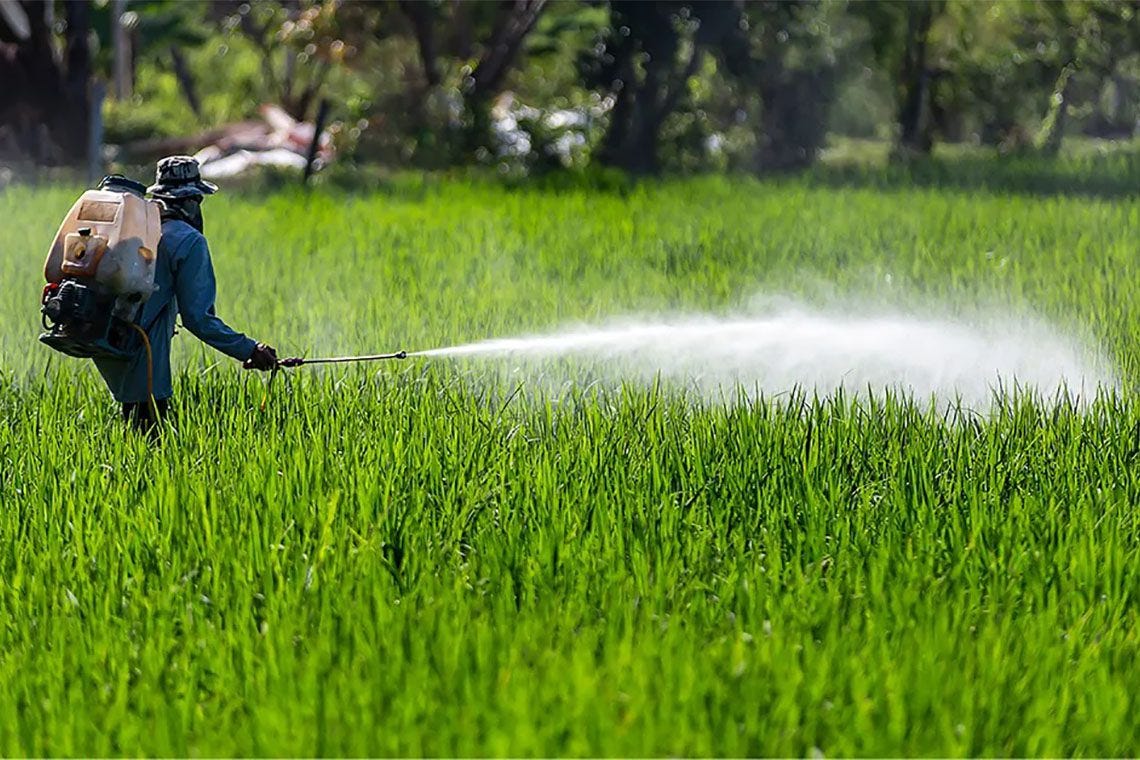
What is Glyphosate?
Glyphosate is a broad-spectrum systemic herbicide and crop desiccant, classified as an organophosphorus compound and specifically a phosphonate. It acts by inhibiting the enzyme 5-enolpyruvylshikimate-3-phosphate synthase (EPSPS), which is essential for the synthesis of aromatic amino acids in plants and some microorganisms, thereby preventing plant growth and leading to their death.
It is the active ingredient in many herbicide products, most notably Monsanto’s Roundup (acquired by Bayer in 2018), and is used extensively in agriculture, forestry, lawns, gardens, and public spaces to control a wide range of weeds and unwanted vegetation. Glyphosate is non-selective, meaning it kills most plants it contacts, but its use has been greatly enhanced by the development of genetically modified crops engineered to be resistant to it, allowing farmers to apply it post-emergence without harming their crops.
According to the U.S. Environmental Protection Agency (EPA), glyphosate has been used in agriculture since 1974. It’s often sprayed on crops like corn, soybeans, wheat, oats, rape and canola.
These crops are often genetically modified to survive the chemical, which means the weeds die but the crops live.
Even though glyphosate helps increase food production, when it is used as a desiccant it can leave a residue on crops. That means it may be present in the foods we eat.
Related: What is Food Adulteration?
Is Glyphosate dangerous?
It is believed that glyphosate might be harmful, especially when people are exposed to it often or in large amounts. While it doesn’t usually cause instant symptoms in adults, recent research shows it could accumulate and cause damage to the nervous system over time.
Studies have shown that glyphosate and the chemicals it’s mixed with (known as glyphosate-based herbicides or GBHs) can affect the brain and nervous system in animals and in human cells. In some cases, glyphosate has been linked to:
DNA damage
Changes in the brain and nervous system
Problems with memory or behaviour
Neuroinflammation (swelling in the brain)
Parkinsonism (a group of symptoms similar to Parkinson’s disease)
Researchers found that glyphosate can cross both the placental barrier and the blood-brain barrier (which usually protects the brain from harmful substances). That means it may reach the brain and possibly affect how it works, especially in unborn babies and young children whose brains are still developing.
This ability to cross these protective barriers has been demonstrated in studies using animal models, where glyphosate was detected in the brain and cerebrospinal fluid of subjects under acute intoxication. https://www.sciencedirect.com/science/article/abs/pii/S0269749120368688
Additionally, studies using ex vivo placental perfusion have shown that glyphosate and its formulations, such as Roundup™, can transfer to fetal circulation, with transfer rates reaching up to 15%. https://pmc.ncbi.nlm.nih.gov/articles/PMC9541419/
The presence of excipients in commercial formulations may further enhance this transfer and cause more significant damage to fetal vessels compared to glyphosate alone. This capability raises concerns about the potential neurodevelopmental and developmental toxicity of glyphosate, particularly during critical periods of brain development. https://www.sciencedirect.com/science/article/abs/pii/S0048969723056590
However, not all experts agree. Some say glyphosate is safe in small amounts found in food. But because of the risks shown in lab studies and real-life exposures, many people choose to limit their intake especially for children, pregnant women, or anyone with health concerns.
Take a look at this list of foods which tend to carry the highest risk : https://algaecookingclub.com/zine/glyphosate-free-foods-list
Can I buy glyphosate-free food in the UK?
It is possible to buy glyphosate-free food in the UK. Several brands and retailers offer products certified as glyphosate-free, often through third-party testing and certification programs. For example, Wedderspoon labels certain products, such as its Apple Cider Vinegar and Manuka Honey Snap Packs, with a glyphosate-free logo to indicate they have been tested and verified to be free of glyphosate residues.
The Detox Project offers a “Glyphosate Residue Free” certification, which requires products to have no detectable glyphosate residues down to government-recognised limits of detection (typically 0.01 ppm), and this certification is available for a range of food and supplement products.
Retailers like Thrive Market also offer glyphosate-free foods online.
Choosing organic products is a reliable way to minimise exposure, as organic farming standards prohibit the use of glyphosate.
While organic certification does not guarantee zero contamination due to potential cross-contamination from neighbouring fields or processing facilities, it significantly reduces the likelihood of glyphosate presence compared to conventionally grown foods Some brands, such as Biona, claim their crops are grown without any herbicides or pesticides, including glyphosate. I buy my pure cranberry juice from this brand but it is very expensive at £11 per litre.
We can also look for products labelled “glyphosate-free” on packaging, which may indicate that the product has undergone testing to confirm the absence of the chemical. However, it is important to note that while these labels provide reassurance, the availability of certified glyphosate-free products remains very limited, and widespread testing of the UK food supply has found glyphosate residues in many common items, especially bread and oat-based cereals and flours.
Glyphosate Found in UK Food
Widespread testing of the UK food supply has detected glyphosate residues in various food products, particularly in cereals, bread, and oats. A 2016 survey by the Pesticide Action Network UK found that 63% of wholemeal bread samples contained glyphosate residues. More recent data from the UK’s competent authorities for pesticide residues in food, published in 2022, confirmed that glyphosate was tested in 84 samples of barley products, bread, and oat products in Northern Ireland. The UK government’s residue testing programme has consistently found glyphosate in grain-based products, with levels typically below the EU’s Maximum Residue Level (MRL) of 0.01 mg/kg. However, concerns persist, as the presence of glyphosate in staple foods like bread and cereals is largely attributed to its use as a pre-harvest desiccant to dry crops before harvesting. A 2018 study found glyphosate in organic products such as Tesco Organic Plain Flour and Waitrose Duchy Organic Farmhouse Batch wholemeal bread, though at levels below the quantification threshold of 0.01 mg/kg. Despite official assurances that these levels are safe, campaigners and scientists argue that long-term exposure to glyphosate, especially in combination with other pesticides (known as the “cocktail effect”), poses potential health risks. The World Health Organization’s International Agency for Research on Cancer has classified glyphosate as “probably carcinogenic to humans,” a finding that has fuelled calls for stricter regulation and greater transparency in food testing.
Sadly, glyphosate has been found in both coffee and tea.
Independent testing has detected glyphosate residues in tea products, including popular brands like Twinings. A 2019 lawsuit revealed that some green tea samples contained up to 0.332 mg/kg of glyphosate. Glyphosate can enter tea through direct application, soil absorption, spray drift, or contaminated water. Major tea-producing countries have varying maximum residue limits (MRLs), with the EU and UAE setting a strict limit of 0.01 mg/kg, while the UK allows up to 2.0 mg/kg.
Glyphosate residues have been detected in green coffee beans, with international standards permitting up to 1 mg/kg (1 ppm). While processing and brewing can reduce glyphosate levels, some residues may still remain in the final beverage.
What do the authorities say about Glyphosate?
Regulatory bodies differ on glyphosate’s safety, with the International Agency for Research on Cancer (IARC) classifying it as “probably carcinogenic,” while others maintain it is safe within legal limits.
The IARC report on glyphosate is published in IARC Monographs Volume 112, titled ”Some Organophosphate Insecticides and Herbicides”, released in 2015. https://www.iarc.who.int/wp-content/uploads/2018/07/MonographVolume112-1.pdf
Key Finding: ”probably carcinogenic to humans” (Group 2A) based on:
- Limited evidence of cancer in humans (specifically non-Hodgkin lymphoma).
- Sufficient evidence of cancer in experimental animals.
- Strong evidence of genotoxicity for both pure glyphosate and its formulations.
What are the alternative options to glyphosate ?
Considering the likelihood of glyphosate being banned, or at the very least greatly controlled in the coming years, what are the viable alternatives ? In its report Integrated weed management, pesticide action network and the Greens have highlighted some elements that could help in reducing our reliance on glyphosate.
While biological pesticides have been successfully used to control fungi and pests populations, this has proven to be quite difficult to apply to weed control, especially considering a single field can be the target of a dozen species of different weeds. However, bioherbicides have the advantage of a very high selectivity (which means there is very little effect on non-target and beneficial plants), ensure that there is no build-up of residue in the environment and it can also help with managing herbicide-resistant weed populations.
Mechanical treatments are also a solution. Thanks to the development of organic agriculture, great advancements have been made to weeding machinery that can now cover a wide array of weed control needs. Spring tine weeders, spoon weeder, aerostar rotation, parallelogram inter-row hoes are some examples among the plethora of mechanical weed control solutions that are available nowadays. This type of technology is also concerned by the digital and AI revolution with companies working on autonomous weeding robots. ~ https://www.alcimed.com/en/insights/end-glyphosate-europe-perspective-alternatives/
Although that article ^^ suggests that the EU may ban Glyphosate eventually, I would prefer to avoid all chemicals immediately if I possibly can.
You may agree with me about that.
ONWARDS AS ALWAYS!
xx
If you appreciate my research but cannot commit to a paid subscription you could buy me a coffee at: https://www.buymeacoffee.com/FrancesLeader
Please note that all my work is entirely free to read and will never be hidden behind a paywall. My lovely paying subscribers contribute knowing this to be true and I would like to take this opportunity to thank them very much for their ongoing support.
The important thing is sharing this educational information on social media, especially on X and Facebook and Discord where I am permanently excluded because my work upsets the totalitarians.
Previous research published in 2023 -
https://francesleader.substack.com/p/a-question-about-glyphosate
I’ve always found it alarming farmers wearing full hazmat suits to spray crops for us to go on & eat. Often wondered do farmers eat the crop they poison?