
DEMORALISATION + TRUTH DECAY
With a sobering lessons on psyops from Yuri Bezmenov and Grok

Demoralisation is a psychological state characterised by hopelessness, helplessness, and a loss of meaning or purpose in life. It is quite distinct from depression because demoralised individuals can still experience pleasure in the present but lack hope for the future. First defined by Joseph Frank in 1961, it is a persistent subjective inability to cope with stressors, often leading to feelings of subjective incompetence and failure to meet personal or external expectations.
In clinical settings, particularly palliative care and oncology, demoralisation is a significant concern with a prevalence of 13%–18% among cancer patients. It is closely linked to suicidal ideation and a desire for hastened death, often exceeding depression for these outcomes.
Beyond clinical contexts, the term refers to the erosion of morale in warfare, where it is used as a tactic in psychological warfare to induce retreat or surrender by undermining enemy confidence. It also describes the disintegration of group discipline or the corruption of moral standards within organisations or societies.
In 1984, G. Edward Griffin interviewed former KGB Yuri Bezmenov. Titled 'Soviet Subversion of the Free World Press'. In the interview, Bezmenov explained the methods used by the Soviet Union KGB for the gradual subversion of the political system of the United States which inevitably has led to a deep demoralisation among all capitalist countries.
I recommend listening closely to this man. He reveals a great deal about who are useless idiots and what their and our fate may be in a totalitarian future.
Bezmenov insisted that in the 1980s we were at war and demoralisation was a key psychological operation at that time.
Grokipedia has compiled a page on the history and development of demoralisation which is worth reading to bring us up-to-date.
The inability to believe and trust information sources has created a profound state of societal demoralisation, characterized by hopelessness, cynicism, and a collapse of epistemic authority (the power of institutions to define truth). This phenomenon, termed “Truth Decay” manifests through several psychological and social mechanisms as laid out in the book by that name.
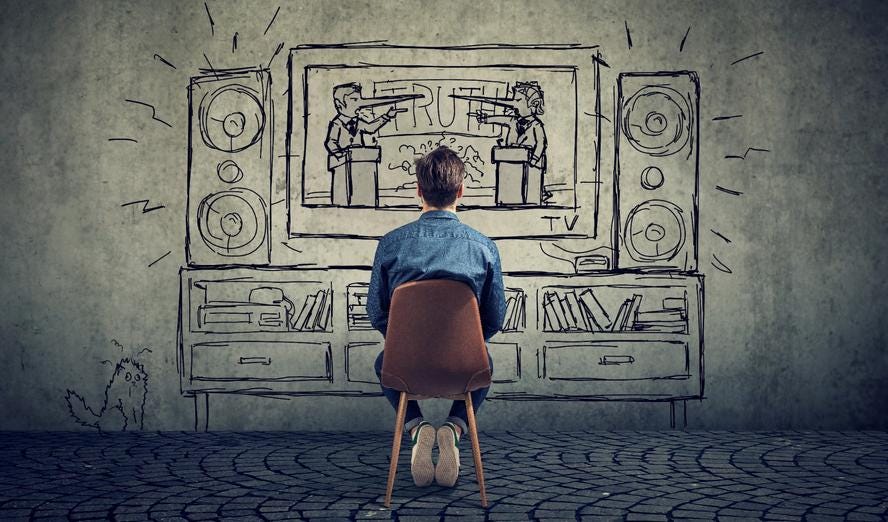
1. The Cycle of Overload and Distrust
The modern information environment creates a vicious cycle where information overload makes it impossible to verify facts, providing fertile ground for misinformation to thrive.
Psychological Impact:
Constant exposure to conflicting and sensationalised information leads to emotional fatigue, anxiety and confusion. Individuals often respond with information avoidance (withdrawing from news entirely) or cognitive disengagement, feeling helpless to distinguish truth from fiction.
This exhaustion fosters a generalised digital distrust, where people stop trusting any source, potentially leading to a paralysis in decision-making and a sense of instability.
2. Erosion of Epistemic Authority
Trust in traditional pillars of truth such as science, media, government, and universities—has collapsed to historic lows.
Without agreed-upon facts, society fractures into isolated realities. This makes empathy and compromise impossible, as groups literally disagree on the most fundamental matters. Nobody is sure what is real. The breakdown of institutional trust triggers a “moral shock” where assumptions about fairness and integrity are shattered. This leads to existential unease and a belief that the world is inherently unsafe and unpredictable.
3. Mental Health and Social Consequences
The inability to trust information is not just a political issue but a public health crisis. Prolonged exposure to the “infodemic” correlates with higher rates of depression, stress, and hopelessness. People feel overwhelmed by “doom-laden” fake news and powerless to effect change.
Distrust fuels polarisation and cyber violence. As people retreat into echo chambers that confirm their biases, societal cohesion erodes, and collective action on critical issues becomes impossible.
4. Coping Mechanisms and Polarisation
In response to this demoralisation, society often adopts maladaptive coping strategies such as a defensive cynicism, expecting the worst from all institutions to avoid disappointment. While protective, this kills curiosity and intimacy.
To regain a sense of certainty, individuals cling tightly to ideological groups or charismatic figures who offer simple, albeit often false, narratives. This deepens division and makes the restoration of trust even harder.
The most immediate defence against demoralisation is equipping individuals with the tools to verify information independently BUT censorship is eroding our access to a wide range of opinions. Websites disappear in unremarkable puffs of smoke.
We find ourselves gazing off into the distance, wondering how we ever trusted anything!
I wish I could end this essay with a solution for our truth decay…..
I will let you know if I think of anything!
ONWARDS!
xx
If you appreciate my writing but cannot commit to a paid subscription you could buy me a coffee at: https://www.buymeacoffee.com/FrancesLeader
Please note that all my work is entirely free to read and will never be hidden behind a paywall. My lovely paying subscribers contribute knowing this to be true and I would like to take this opportunity to thank them very much for their ongoing support.
The important thing is sharing this educational information on social media, especially on X and Facebook and Discord where I am permanently excluded because my work upsets the totalitarians.
Seams important to me to constantly remember that we all come from completely different worlds.
The world I am happiest in is the world of structural engineering,very, very, challenging, complex , beautiful , elegant. I obviously didn't believe a word of the story we all told about the events of the ninth of September 2001. Even as that first plane disappeared into the north tower , I was thinking surely no one's going to believe this nonsense. But I was stumped as to just where the towers ended up 'cos it looked to me as though they turned to dust and blew away across the Hudson into NJ.
It wasn't till Dr Judy Wood published her book explaining the mechanism that dustified the towers that all my questions were answered. If you have been blessed with a naturally inquiring mind,then all you can do is trust it.
So it looked like the towers blew away. It looks like on both sides of the Atlantic we live in corporatocracies. And it looks like the British State is about to completely disappear.
Just trust that virtually everyone has an agenda and be very on your guard around religious groups such as the environmentalists.
Ironically, I find the complaint within this piece that "we have lost faith in our institutions" itself demoralizing: those institutions have revealed themselves to be eminently worthy of distrust, since they are about control not truth.
So no, I won't be automatically trusting any media. While the piece refers to "cynicism" and "defense mechanisms" I find this mindset of critical thinking to be liberating, not demoralizing.